







Summary:
VAT filing is an important compliance responsibility for businesses registered under Value Added Tax (VAT) in the UAE. Submitting accurate VAT returns on time helps businesses avoid penalties and fines, maintain proper financial records, and ensure compliance with Federal Tax Authority (FTA) requirements.
This step-by-step guide explains the UAE VAT filing process, key requirements, common mistakes, and ways businesses can manage VAT compliance effectively.
Introduction
Since the implementation of VAT in the UAE, registered businesses are required to submit VAT returns to the Federal Tax Authority (FTA) according to their VAT return period. VAT filing involves reporting taxable sales, output VAT, input VAT, and the final VAT amount payable or refundable.
Many businesses face challenges during VAT filing due to calculation errors, incomplete records, missed deadlines, or a lack of understanding of VAT compliance requirements. Following a structured VAT filing process helps businesses improve accuracy, reduce compliance risks, and maintain smooth financial operations.
What Is VAT Filing in UAE?
VAT filing is the process of submitting a VAT return to the Federal Tax Authority (FTA) that provides details of a business’s VAT-related transactions for a specific tax period.
A VAT return includes information such as:
- Total taxable sales
- Output VAT collected from customers
- Eligible input VAT paid on business expenses
- VAT payable or refundable amount
- VAT adjustments, if applicable
VAT-registered businesses must complete and submit their VAT returns within the deadline specified by the FTA.
Step-by-Step VAT Filing Process in UAE
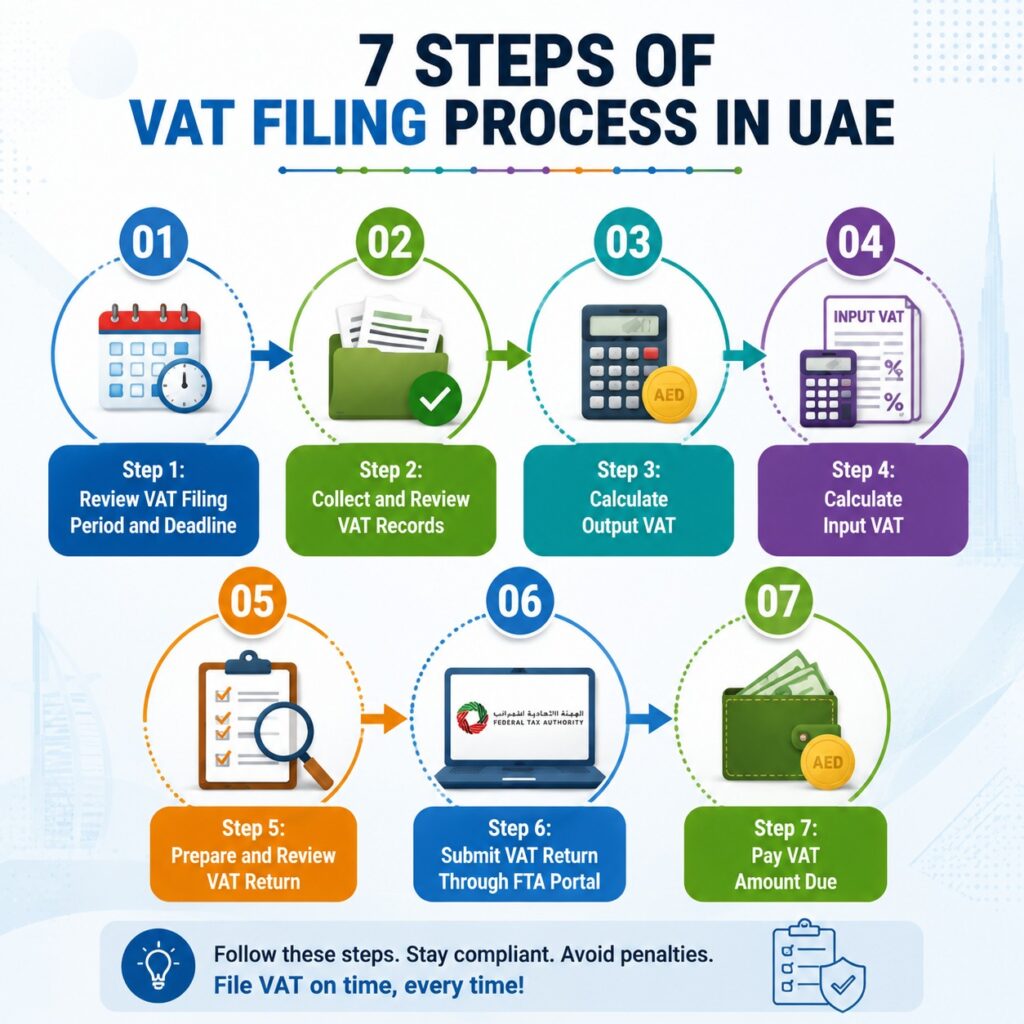
Step 1: Review VAT Filing Period and Deadline
Before preparing a VAT return, businesses should review their VAT Filing details, including:
- VAT return period
- VAT filing deadline
- Business details registered with the FTA
Keeping VAT details updated helps ensure accurate VAT filing and compliance.
Step 2: Collect and Review VAT Records
Proper record-keeping is the foundation of successful VAT compliance. Businesses should maintain complete and organized records of:
- Sales invoices
- Purchase invoices
- Expense documents
- Credit notes and debit notes
- VAT-related transactions
Accurate financial records help businesses calculate VAT correctly and support VAT return submissions.
Step 3: Calculate Output VAT
Output VAT is the VAT collected by a business from customers on taxable supplies.
Businesses should review their sales transactions during the tax period and calculate the correct VAT amount collected. Accurate output VAT reporting ensures that correct information is submitted to the FTA.
Step 4: Calculate Input VAT
Input VAT is the VAT paid by businesses on eligible purchases and expenses.
Businesses can claim eligible input VAT according to UAE VAT regulations, provided they maintain proper supporting documents, such as valid tax invoices.
Maintaining proper records helps businesses accurately calculate their input VAT claims.
Step 5: Prepare and Review VAT Return
After calculating output VAT and input VAT, businesses should prepare their VAT return and review all details before submission.
Businesses should verify:
- Sales and purchase figures
- VAT calculations
- Input VAT claims
- Adjustments
- Supporting documents
A detailed review helps identify errors and improves VAT filing accuracy.
Step 6: Submit VAT Return Through FTA Portal
VAT returns are submitted electronically through the Federal Tax Authority (FTA) portal.
Businesses must:
- Access their FTA account
- Complete the VAT return form
- Review the entered information
- Submit the return before the deadline
Timely submission helps businesses maintain compliance and avoid unnecessary penalties.
Step 7: Pay VAT Amount Due
If the VAT return shows a payable amount, businesses must complete the payment within the required timeframe.
Proper VAT planning and cash flow management help businesses handle VAT payments efficiently without affecting daily operations.
Common VAT Filing Mistakes Businesses Should Avoid
Missing VAT Filing Deadlines
Late VAT return submission can result in penalties and compliance issues. Businesses should maintain a proper VAT calendar to track filing deadlines.
Incorrect VAT Calculations
Errors in output VAT and input VAT adjustments can result in inaccurate VAT returns.
Poor Record-Keeping
Incomplete invoices and missing financial documents can create challenges during VAT reviews or audits.
Incorrect Input VAT Claims
Businesses should ensure that input VAT claims are supported by valid documents and comply with UAE VAT requirements.
Not Reviewing VAT Returns Before Submission
A final review before submission helps identify errors and ensures accurate VAT reporting.
Benefits of Proper VAT Filing
Ensures VAT Compliance
Accurate and timely VAT filing helps businesses meet UAE VAT requirements and maintain compliance.
Reduces Penalty Risks
Following proper VAT procedures reduces the risk of errors, delays, and unnecessary fines.
Maintaining organized VAT records provides better visibility into business transactions.
Supports Business Growth
Proper VAT management allows businesses to focus on growth while maintaining strong financial practices.
How Avana Solutions can help with VAT Filing in the UAE
Managing VAT filing requires accuracy, proper documentation, and knowledge of UAE VAT regulations. Avana Solutions helps businesses simplify their VAT compliance process through reliable VAT support.
Our team provides professional VAT support, including VAT return preparation, VAT filing assistance, VAT compliance reviews, and guidance on VAT-related requirements. We help businesses maintain accurate VAT records, follow UAE VAT regulations, and manage their VAT obligations efficiently.
With expert VAT support, businesses can reduce compliance risks, avoid filing errors, and ensure a smoother VAT filing process.
Conclusion
The VAT filing process in the UAE requires careful preparation, accurate calculations, and timely submission. Maintaining proper VAT records and following a structured filing process helps businesses reduce compliance risks, avoid common errors, and ensure smooth operations.
Effective VAT management allows businesses to meet UAE tax requirements while maintaining accurate financial records and supporting better decision-making.
Avana Solutions provides reliable VAT filing and compliance support, helping UAE businesses manage their VAT obligations with confidence and focus on sustainable growth.